Campus
M4.2 🌱 Protection & Conception 📖 31 parties ☀️ Terroir tropical & sahélien 🌐 English

Crop Rotation and Planning

Maîtriser les rotations pluriannuelles et successions rapides pour ne jamais épuiser le sol et couper le cycle des maladies.

📋 Sommaire des chapitres (31 parties) Afficher / Masquer
1
PARTIE 1 SUR 31 Crop rotation is useful for:
Crop rotation is useful for:

Crop rotation is useful for:

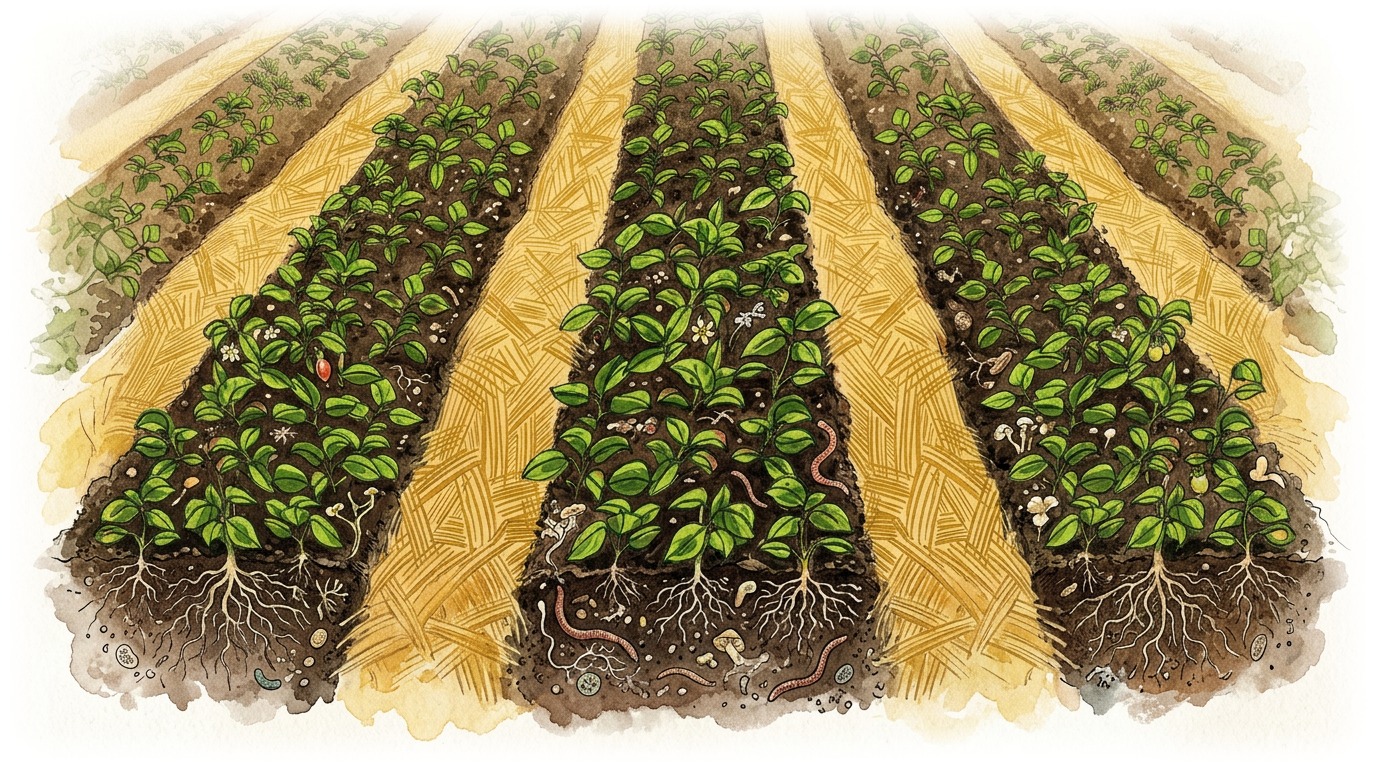
maintaining and increasing soil life and fertility.

increasing production and profitability through rotations that optimize space and compost inputs.

2
PARTIE 2 SUR 31 MARKET GARDENING
MARKET GARDENING

MARKET GARDENING

TRAINING

CROP PLANNING

HOW TO ROTATE CROPS?

3
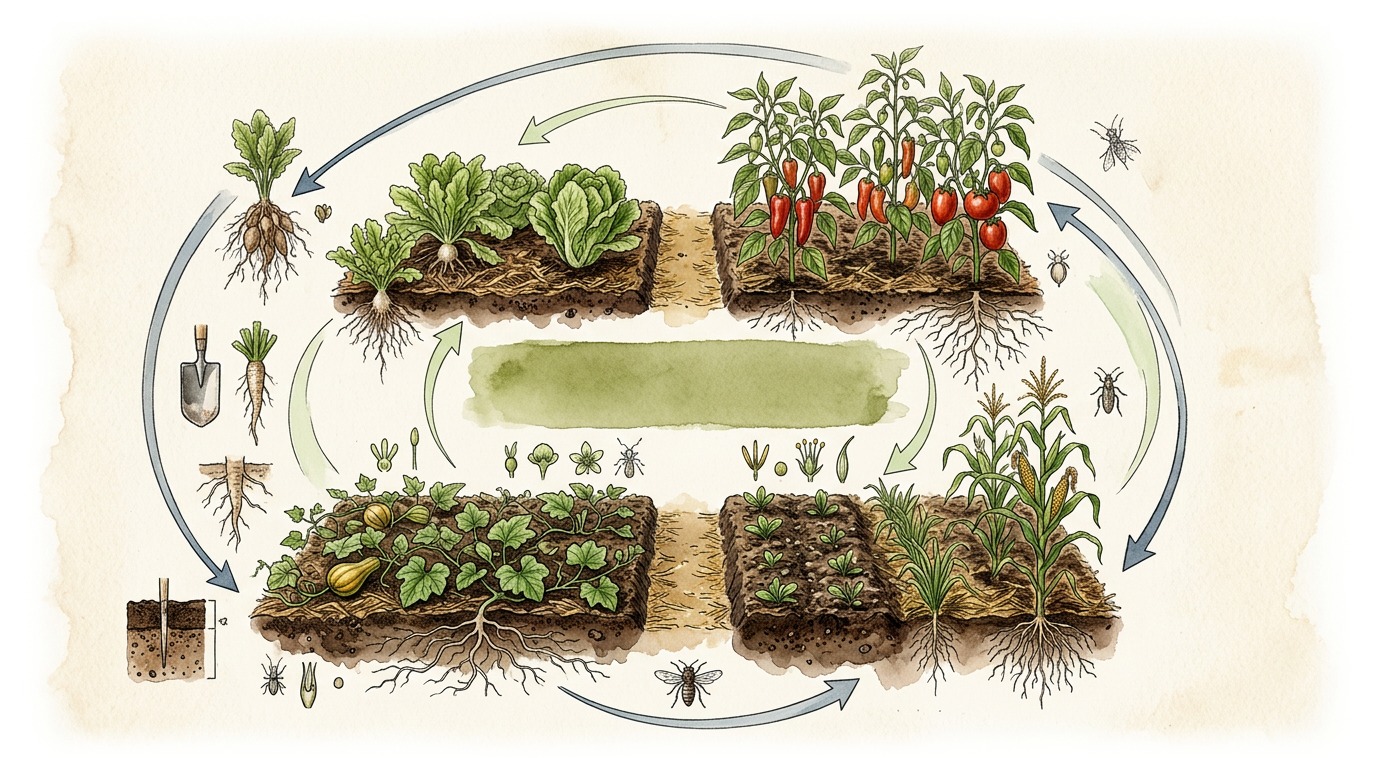
PARTIE 3 SUR 31 Understanding the concepts of crop rotation and succession
Understanding the concepts of crop rotation and succession

Understanding the concepts of crop rotation and succession

Understanding the concepts of crop rotation and succession

4
PARTIE 4 SUR 31 ROTATION
ROTATION

ROTATION

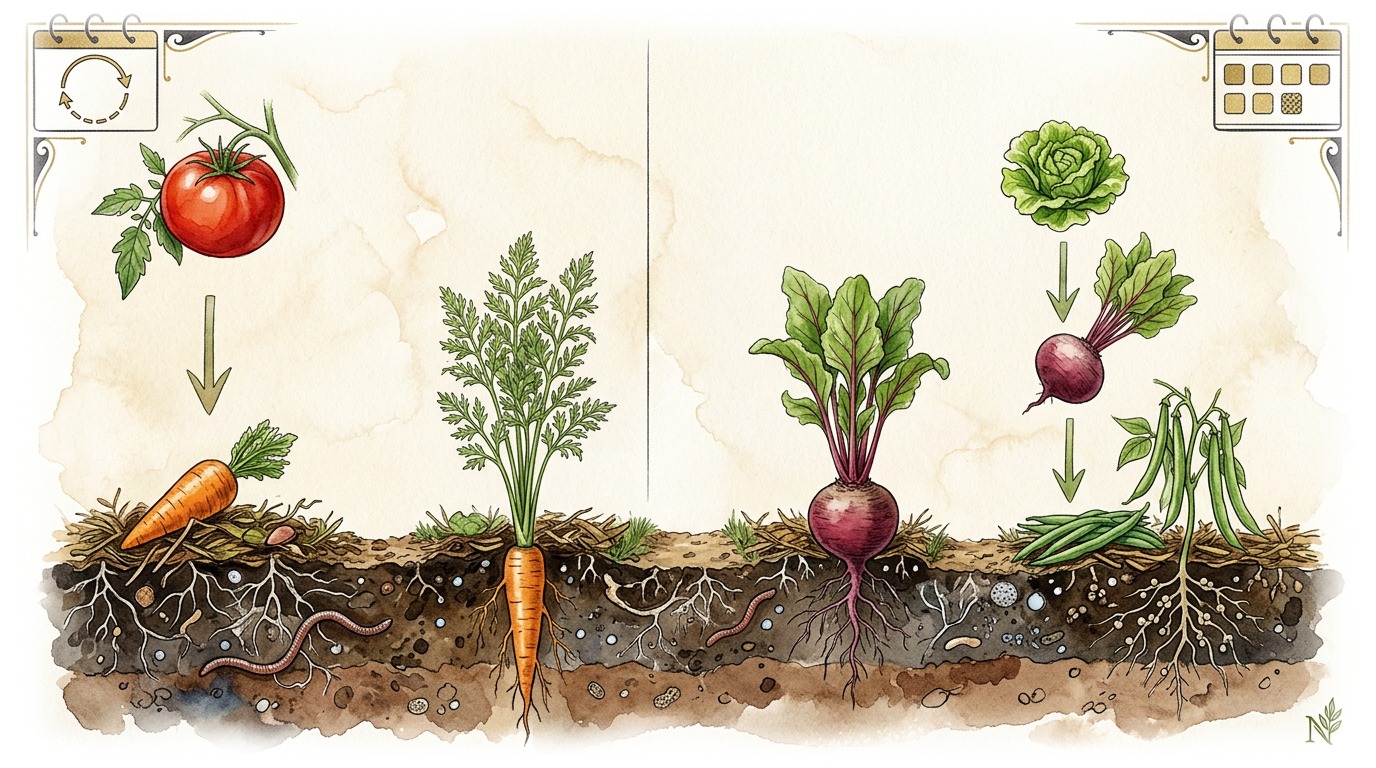
Several seasons or years

Growing tomatoes

SUCESSION

A short year or cycle

Lettuce

Radish

Growing carrots

Dwarf beans

Rotation is the planned alternation of crops over several seasons or years, often to prevent soil depletion and limit

diseases or pests specific to a plant family.

Succession is the sequence of crops grown in the same space over the course of a year or short cycles.

5
PARTIE 5 SUR 31 In our specific context, strict crop rotation is not essential because:
In our specific context, strict crop rotation is not essential because:

In our specific context, strict crop rotation is not essential because:

The soil is continuously improved (compost, permanent cover, organic inputs).

Weeds are limited by breaks and green manure crops.

Crop diversity naturally reduces risks.

What matters most is thoughtful succession and simple alternation between families, root types, and nutritional needs.

6
PARTIE 6 SUR 31 Criteria for choosing crops
Criteria for choosing crops

Criteria for choosing crops

Criteria for choosing crops

7
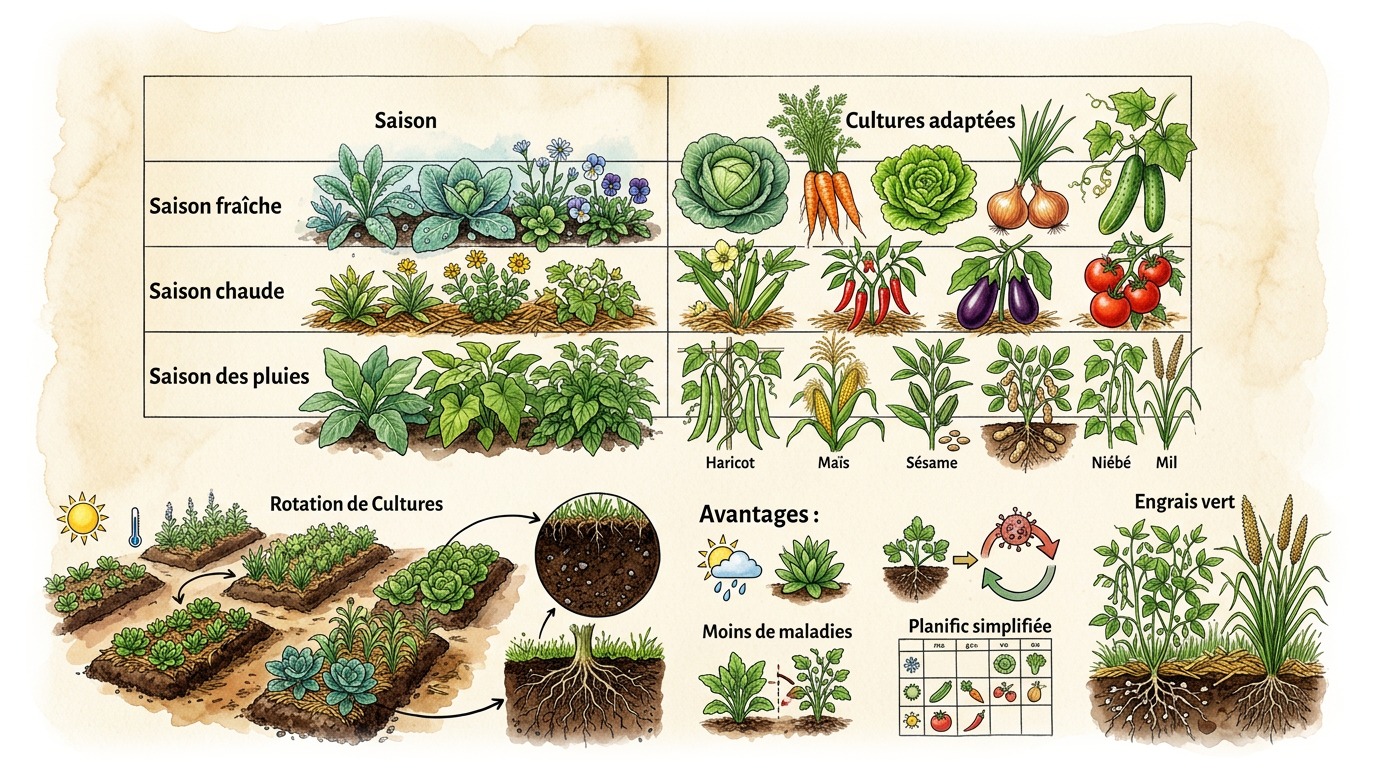
PARTIE 7 SUR 31 Cool season
Cool season

Cool season

Hot season

Rainy season:

moisture-tolerant

crops

Season

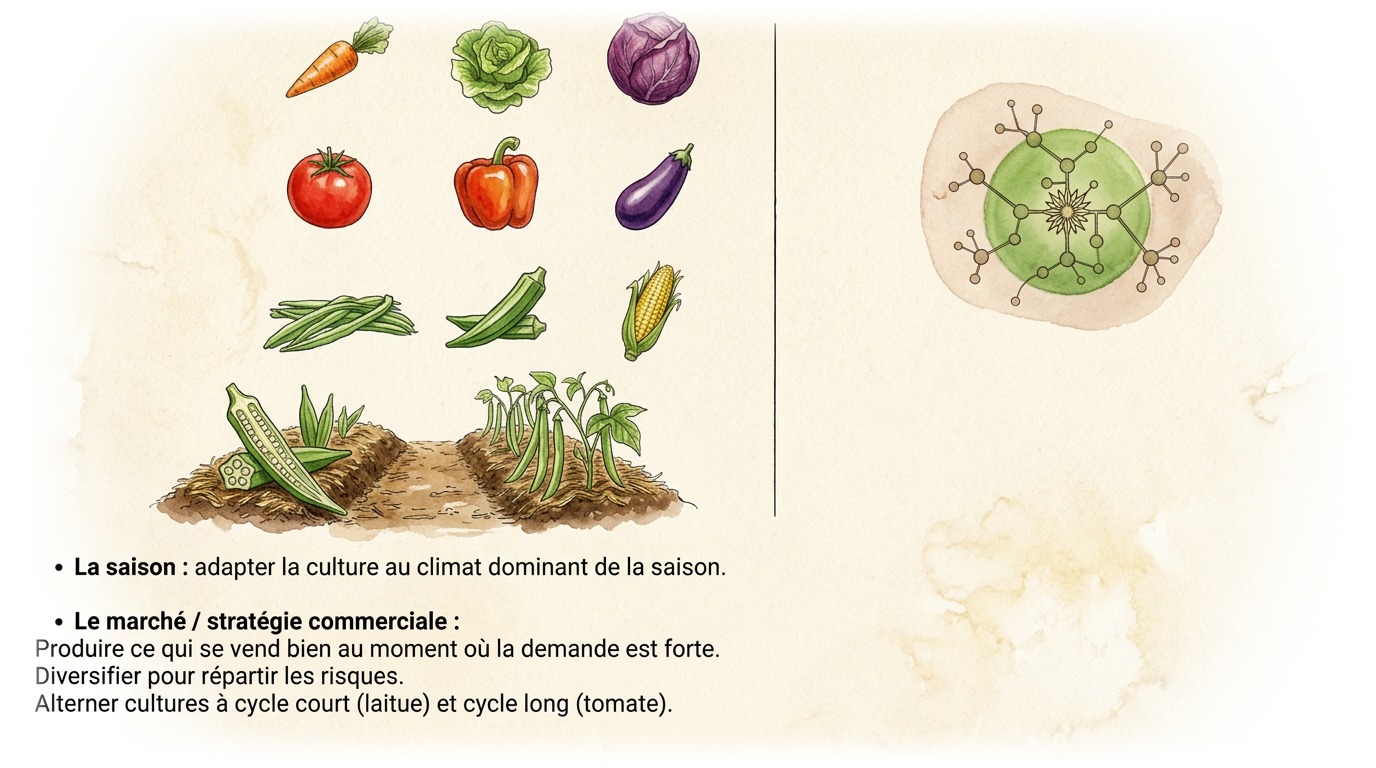
The season: adapt crops to the prevailing climate of the season.

The market/business strategy:

Produce what sells well when demand is high.

Diversify to spread the risk.

Alternate between short-cycle crops (lettuce) and long-cycle crops (tomatoes).

The market / commercial strategy:

8
PARTIE 8 SUR 31 1
1

1

2

3

The question of crop rotation: how to choose which crop to plant based on the characteristics of the previous crop?

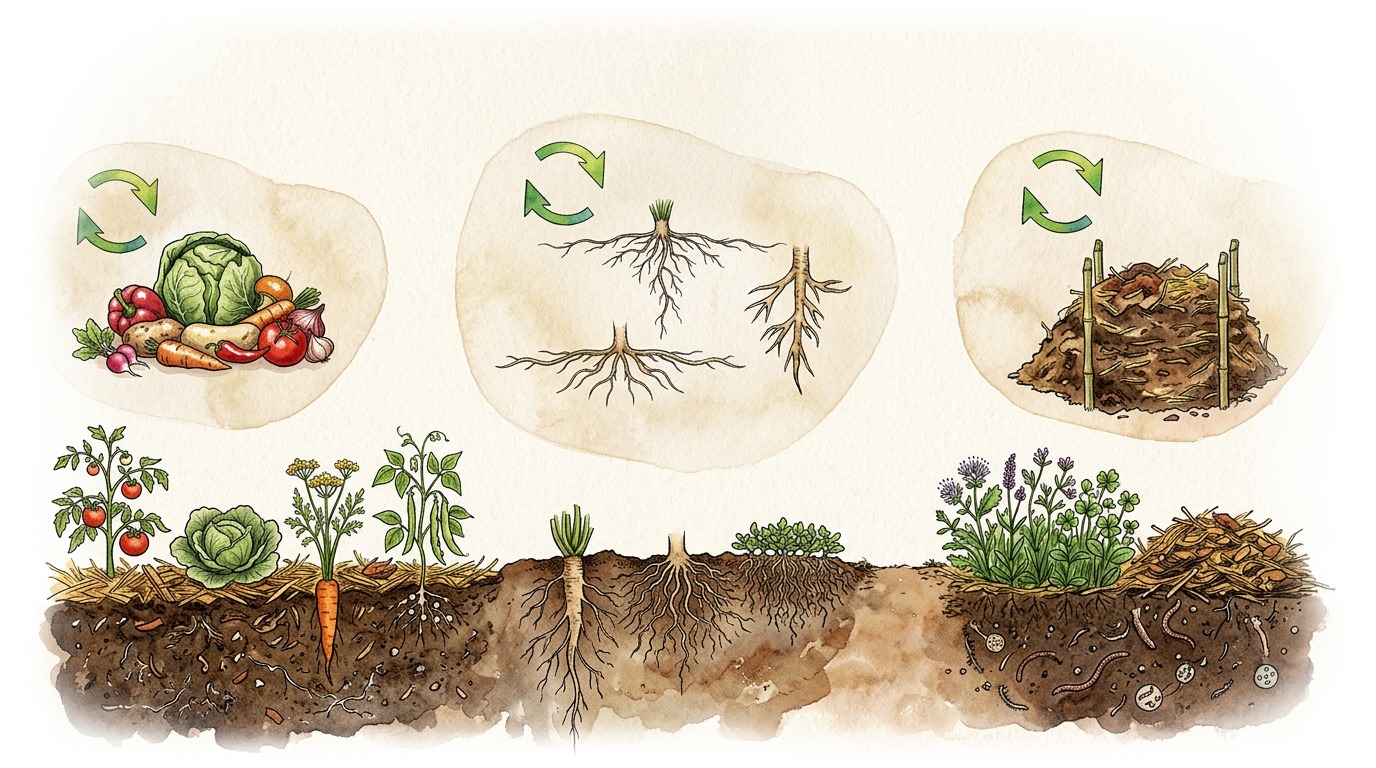
You need to know about:

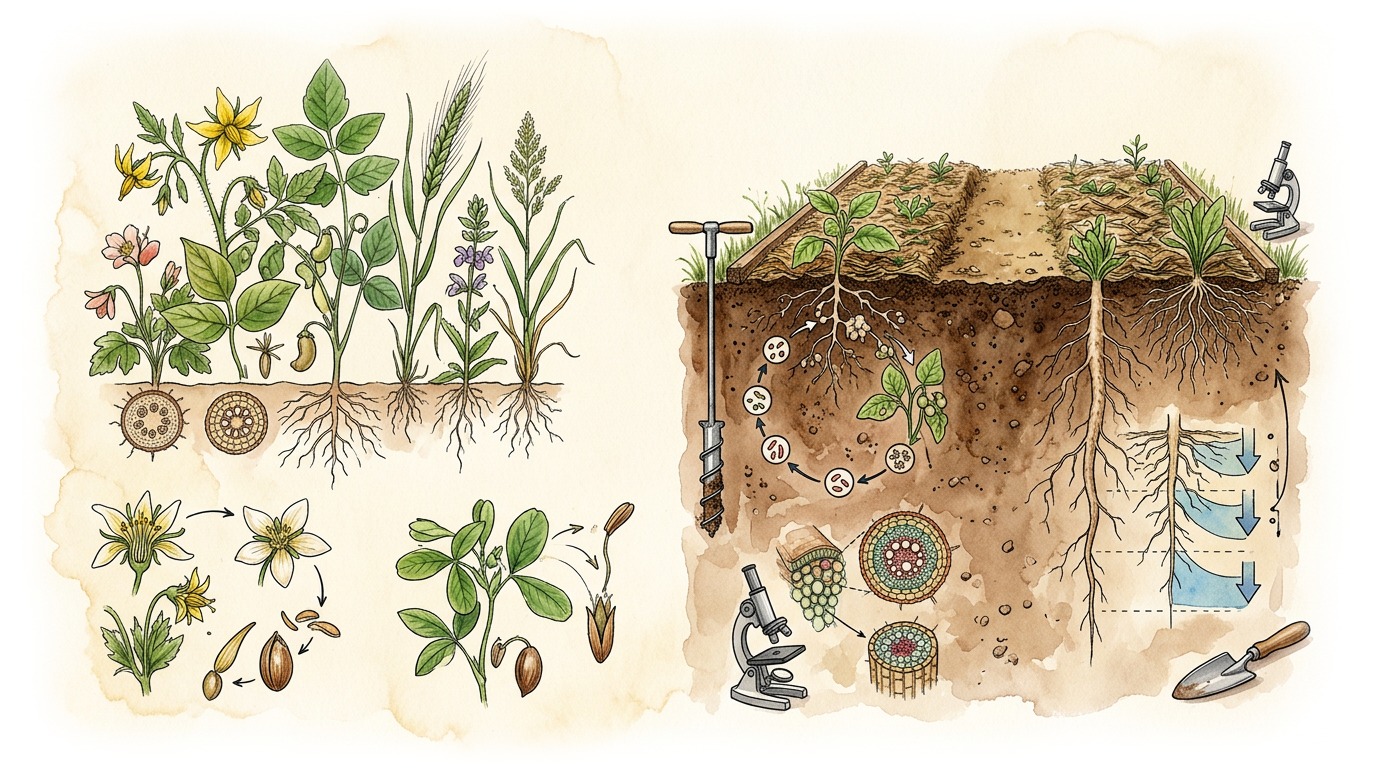
  1. The botanical family: You will need to change families.
  2. The root type: You will need to alternate between deep/shallow/taproot.
  3. Compost requirements: You will need to alternate between heavy and light.
9
PARTIE 9 SUR 31 Why is it important to know about botanical families and root types?
Why is it important to know about botanical families and root types?

Why is it important to know about botanical families and root types?

Why is it important to know about botanical families and root types?

10
PARTIE 10 SUR 31 1
1

1

2

N

Pests/diseases

Ca

P

K

Fe

Mg

Nutritional needs

Root systems

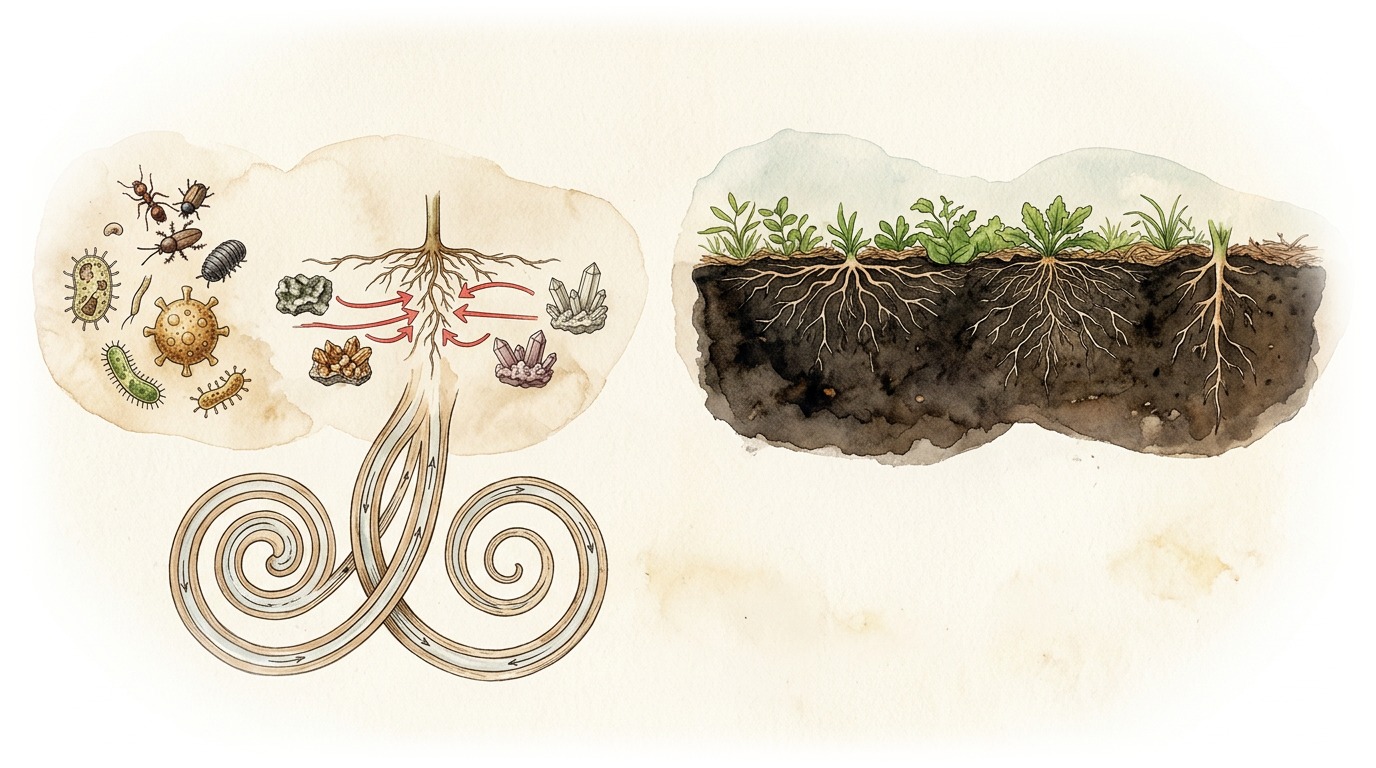
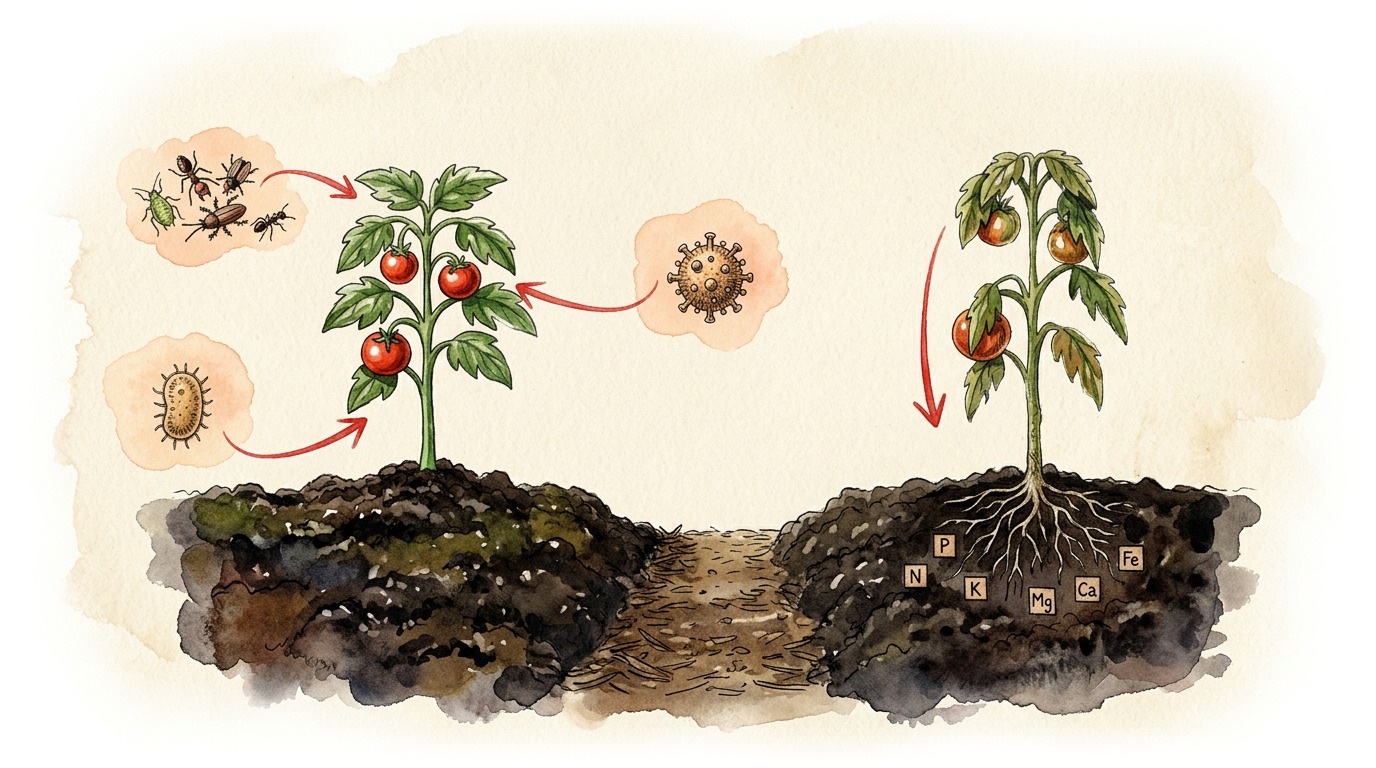
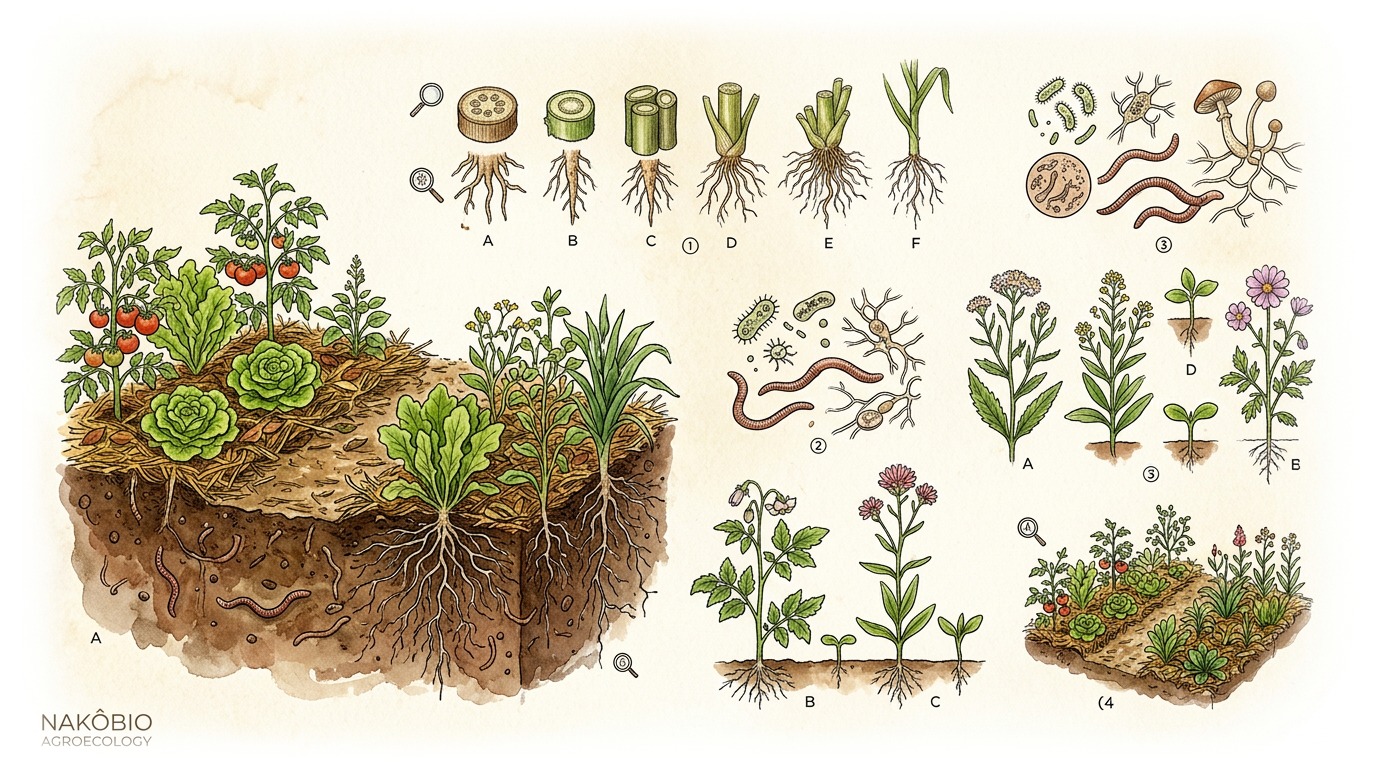
  1. Plants from the same family often share:

The same pests and diseases (late blight for Solanaceae).

The same nutritional needs.

  1. Different root systems exploit different layers of soil (surface vs. depth). Alternating between shallow and deep roots

helps balance soil exploitation.

11
PARTIE 11 SUR 31 Why is it important to know your compost requirements?
Why is it important to know your compost requirements?

Why is it important to know your compost requirements?

Why is it important to know your compost requirements?

12
PARTIE 12 SUR 31 Gourmet crops
Gourmet crops

Gourmet crops

Less resource-intensive crops

Alternating between heavy crops and light crops allows the effort to be spread across the soil.

Compost

Compost

13
PARTIE 13 SUR 31 Resources for effective work-study planning
Resources for effective work-study planning

Resources for effective work-study planning

Resources for effective work-study planning

14
PARTIE 14 SUR 31 1
1

1

2

3

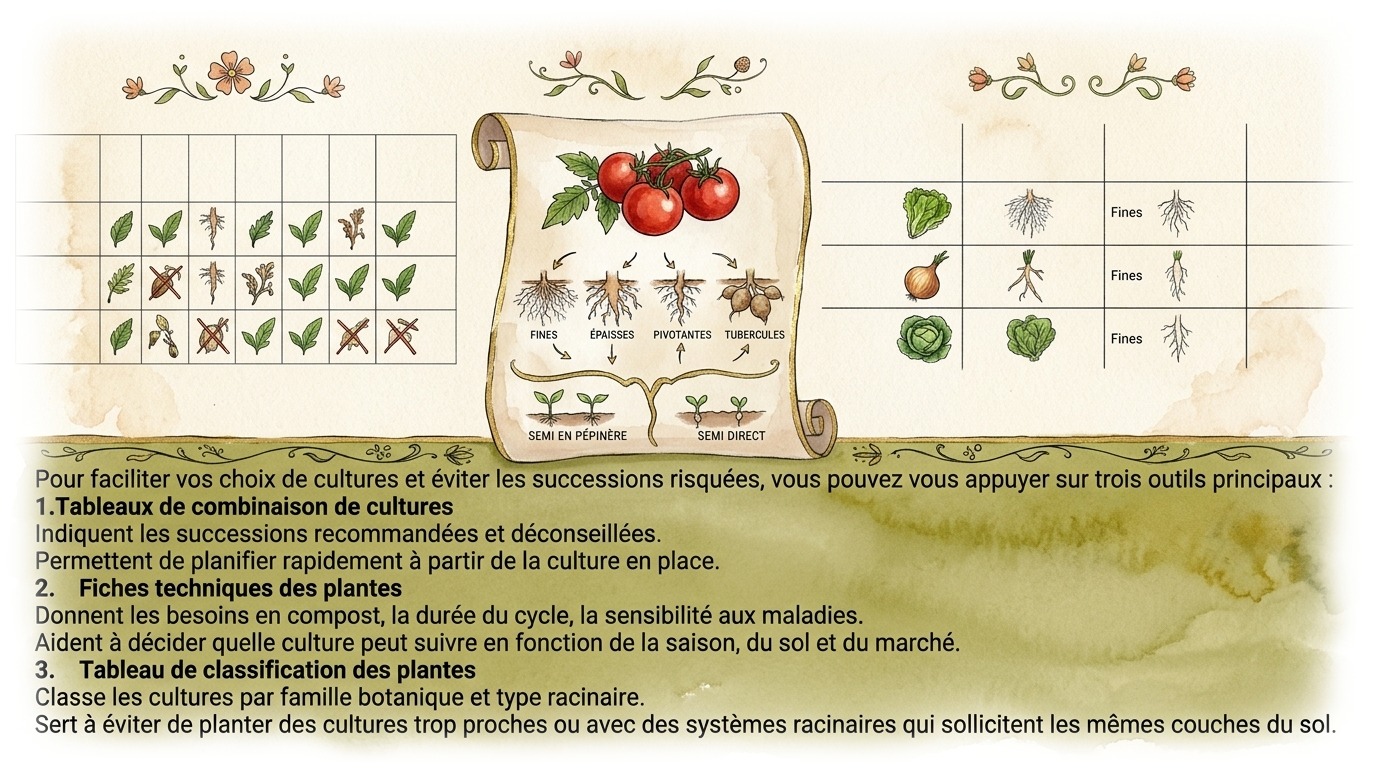
To make your crop choices easier and avoid risky crop rotations, you can use three main tools:

  1. Crop combination tables

Indicate recommended and discouraged crop rotations.

Allow you to plan quickly based on the crop currently in place.

  1. Plant fact sheets

Provide information on compost requirements, cycle length, and disease susceptibility.

Help you decide which crop to plant next based on the season, soil, and market.

  1. Plant classification chart

Classifies crops by botanical family and root type.

Helps you avoid planting crops too close together or with root systems that compete for the same soil layers.

15
PARTIE 15 SUR 31 Example of crop rotation
Example of crop rotation

Example of crop rotation

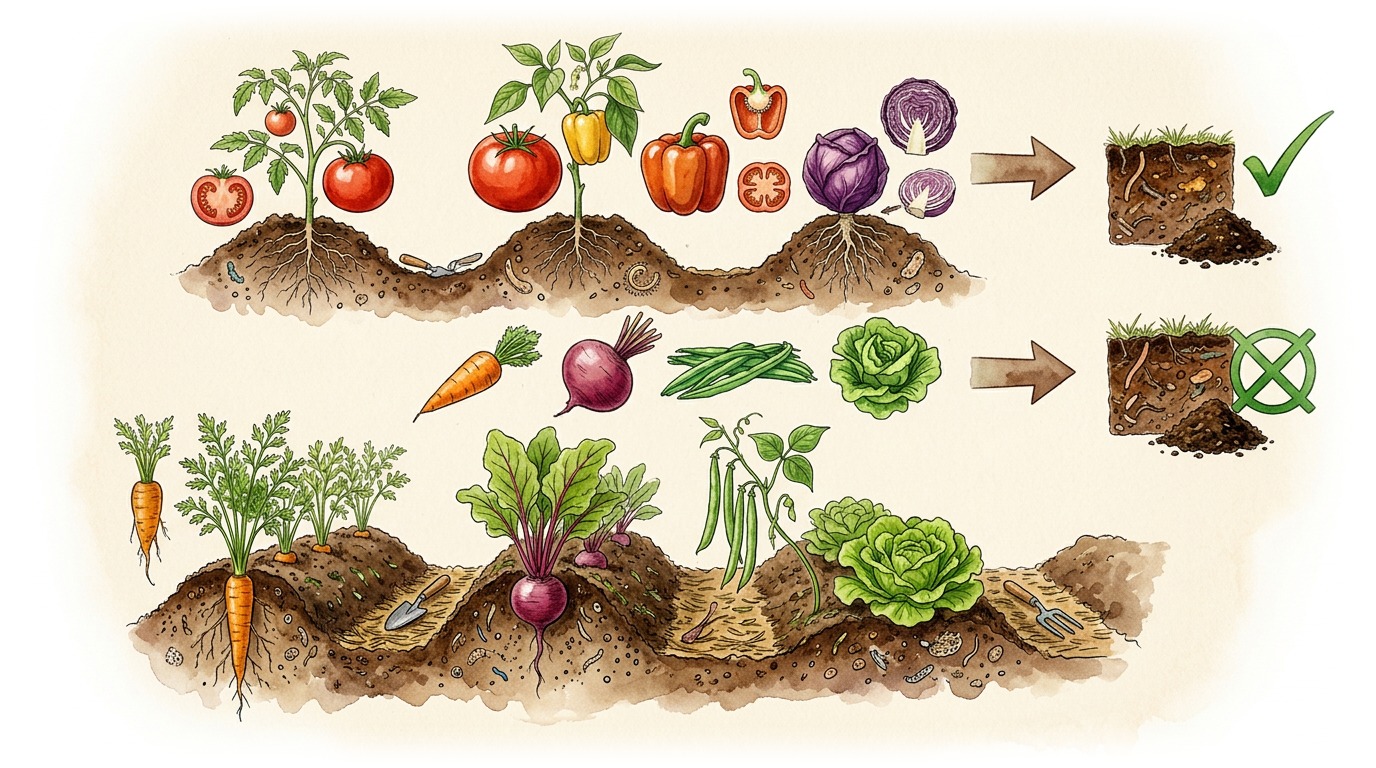
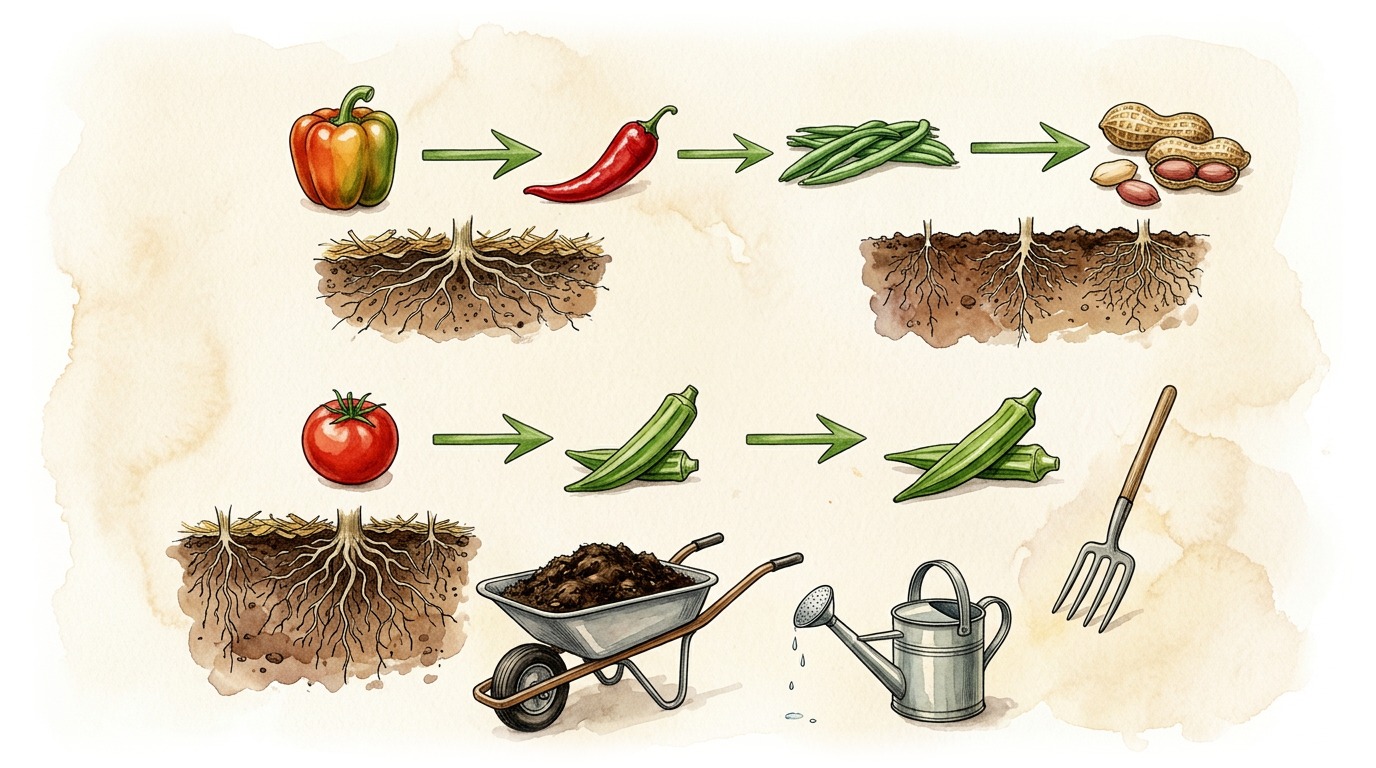
ALTERNATIONS TO AVOID

16
PARTIE 16 SUR 31 DISEASE AND PESTS
DISEASE AND PESTS

DISEASE AND PESTS

POOR SOIL

Virus

Bacteria

N

P

K

Fe

Ca

Mg

Some crop rotations deplete the soil or promote the development of diseases and pests. Here are the main mistakes to

avoid.

17
PARTIE 17 SUR 31 1
1

1

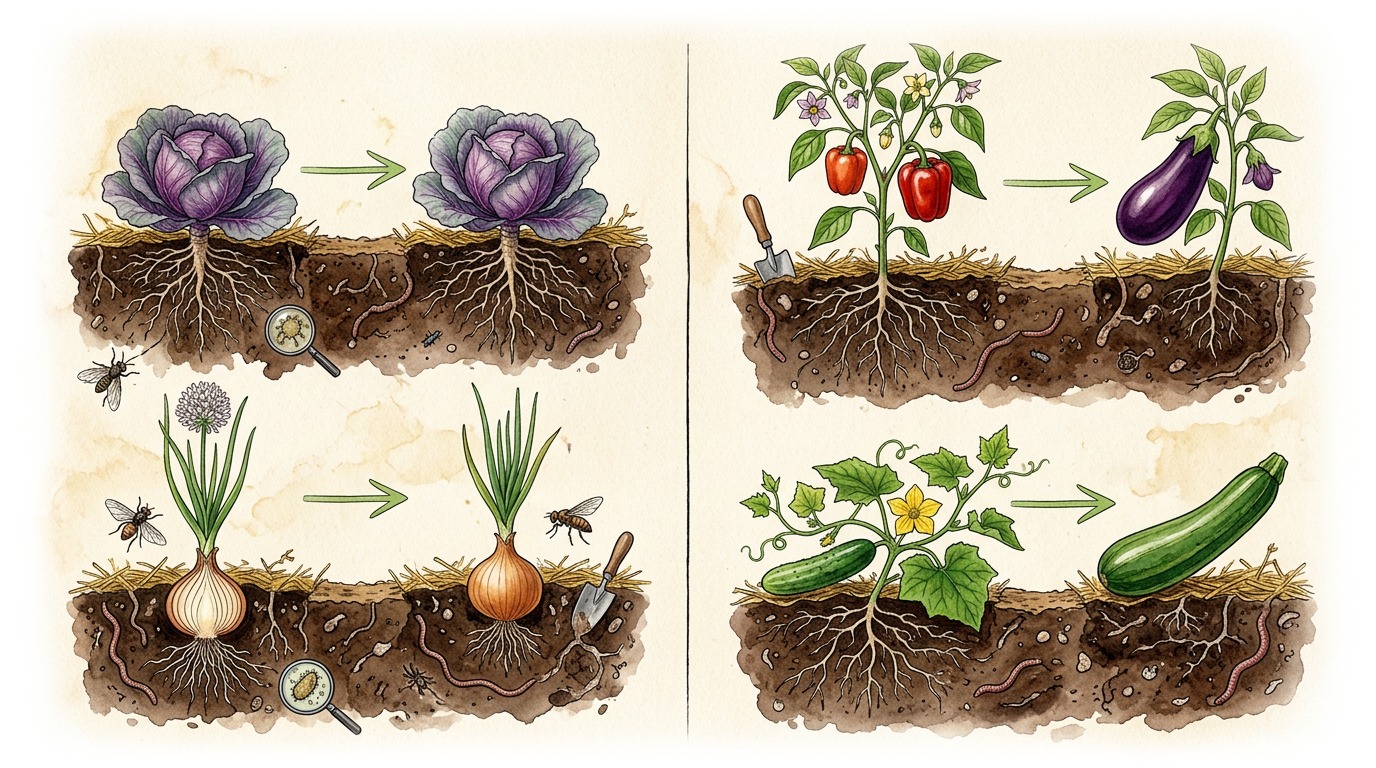
Examples to avoid

classic disease: cabbage hernias

classic pest onion fly

2

both Solanaceae

both Cucurbitaceae

  1. Monoculture

Growing the same plant several times in a row in the same space. This depletes the soil in a targeted manner and

promotes crop-specific diseases.

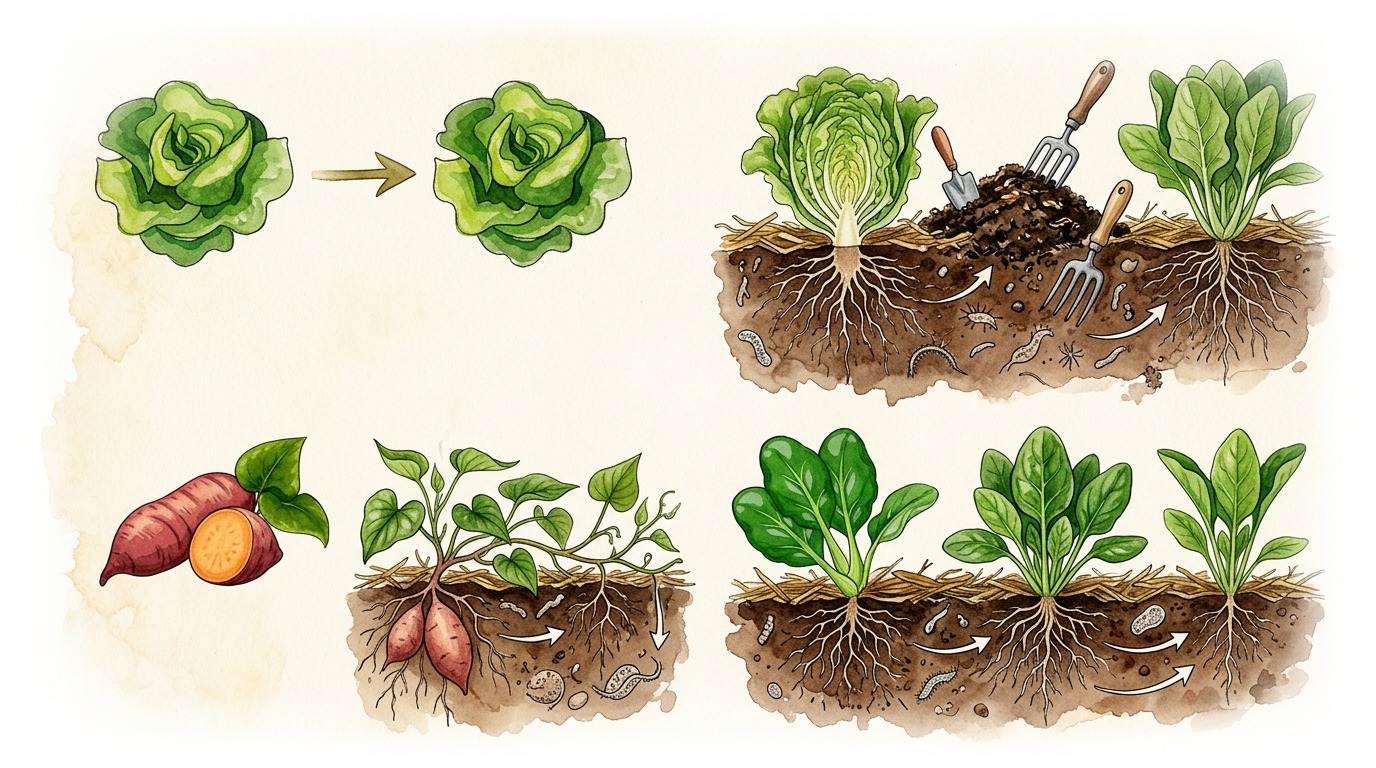
  1. Alternating between plants of the same botanical family

Even if the plants are different, they often share the same pests and diseases.

18
PARTIE 18 SUR 31 Examples to avoid
Examples to avoid

Examples to avoid

3

tracer roots

shallow roots

4

  1. Alternating between plants with the same type of root

The same type of root requires the same depth of soil and often has the same weaknesses when it comes to pests.

  1. Alternating between two very demanding crops

Growing two nutrient-hungry crops in succession, without a break or green manure, severely depletes the soil. Both

require a lot of compost, water, and care.

19
PARTIE 19 SUR 31 Example of crop rotation
Example of crop rotation

Example of crop rotation

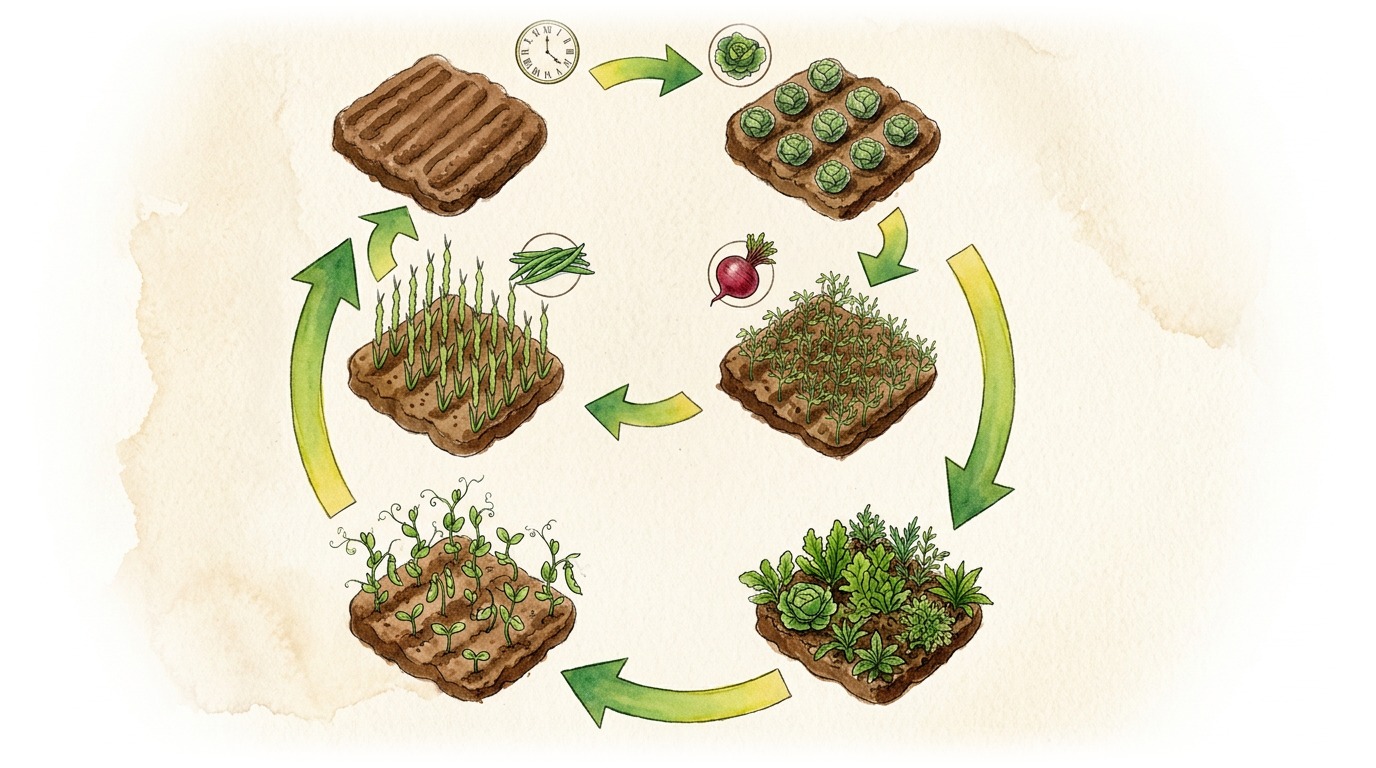
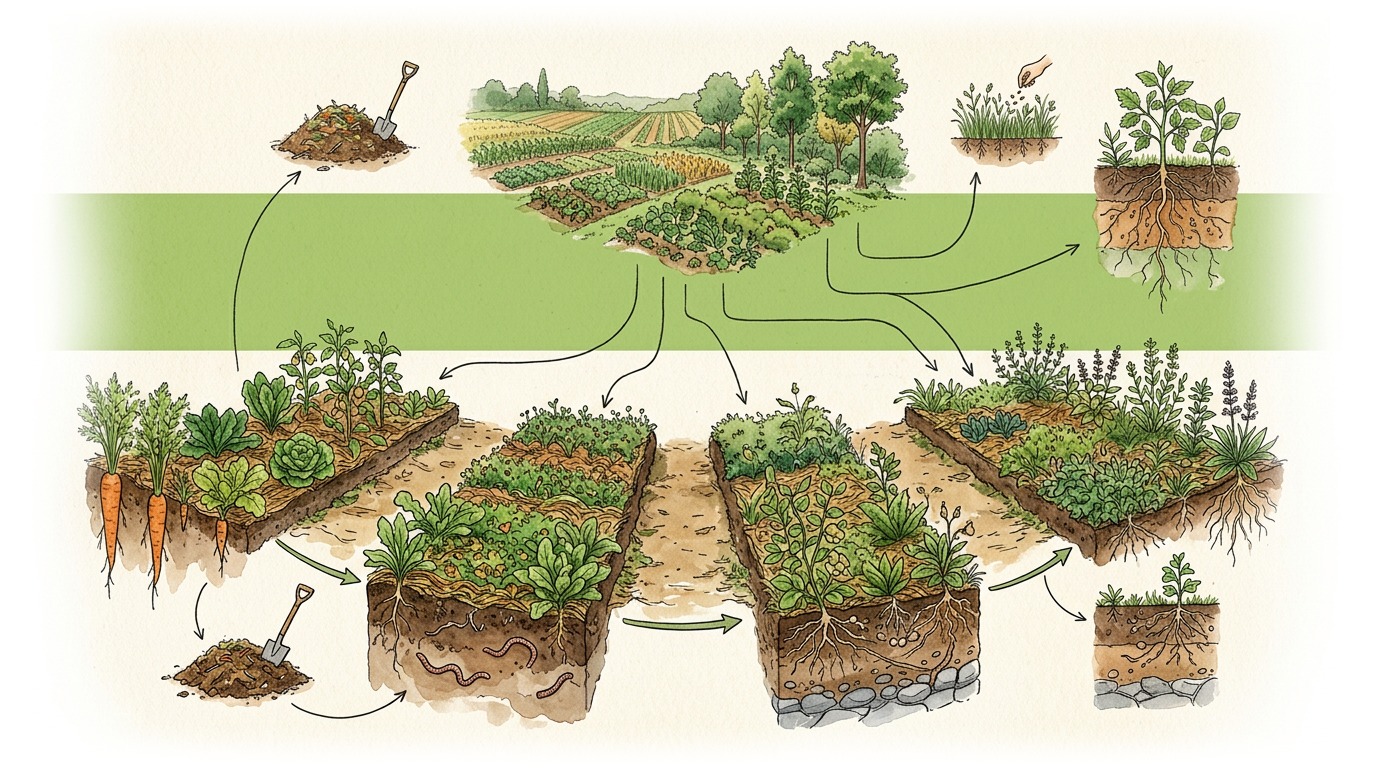
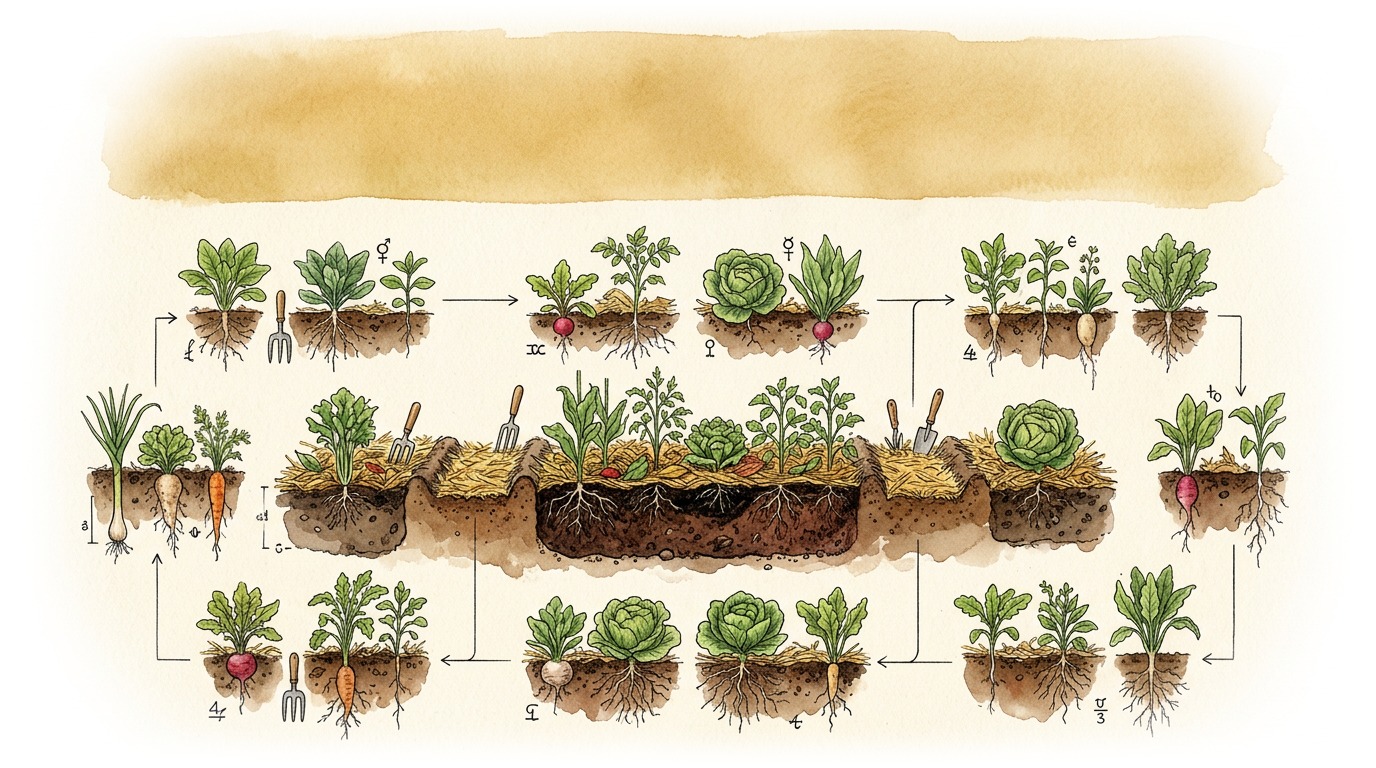
RECOMMENDED CROP ROTATIONS

20
PARTIE 20 SUR 31 Good succession promotes soil health, limits disease, and optimizes the use of resources: water, compost, and labor. Here
Good succession promotes soil health, limits disease, and optimizes the use of resources: water, compost, and labor. Here

Good succession promotes soil health, limits disease, and optimizes the use of resources: water, compost, and labor. Here

are the principles to follow, with concrete examples.

21
PARTIE 21 SUR 31 1
1

1

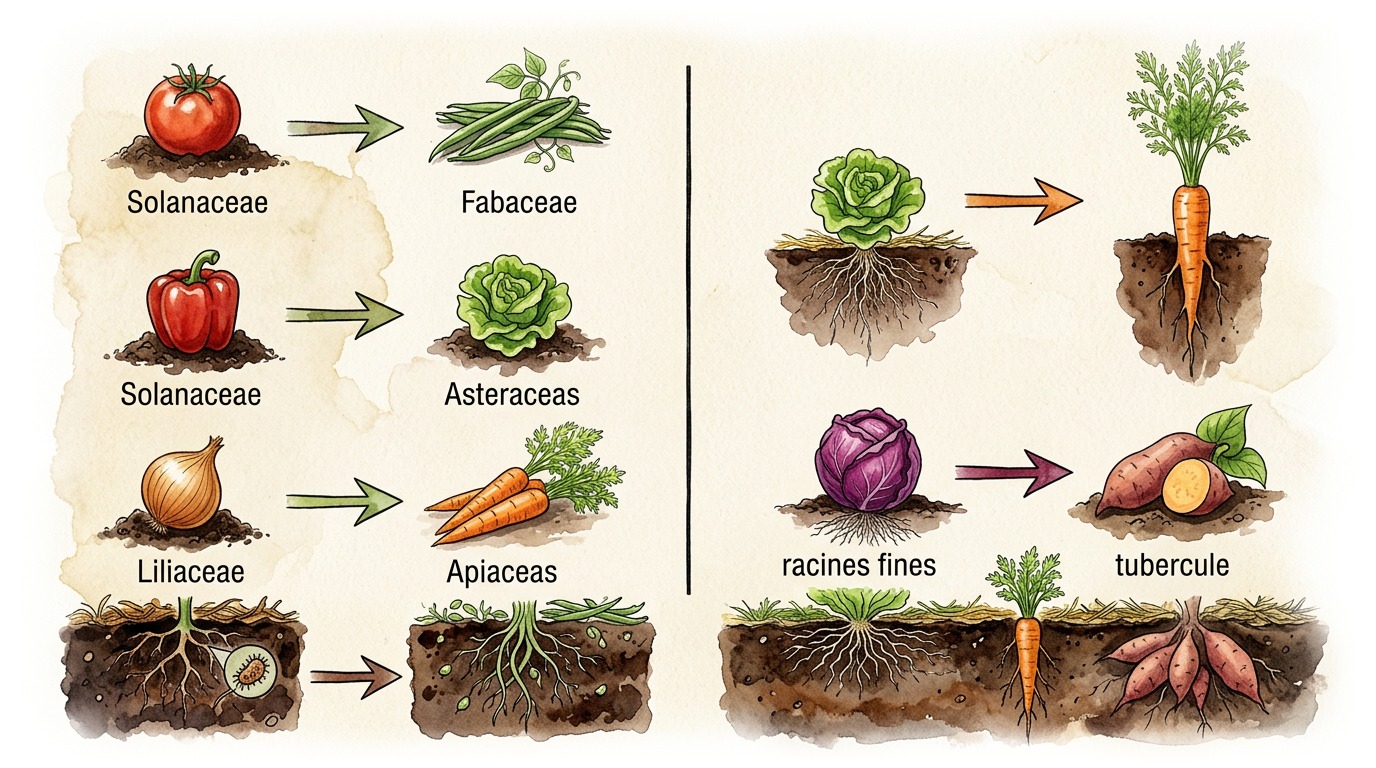
Solanaceae

Recommended examples

2

Fabaceae

fine, shallow roots

Solanaceae

Asteraceae

Liliaceae

Apiaceae

fine roots

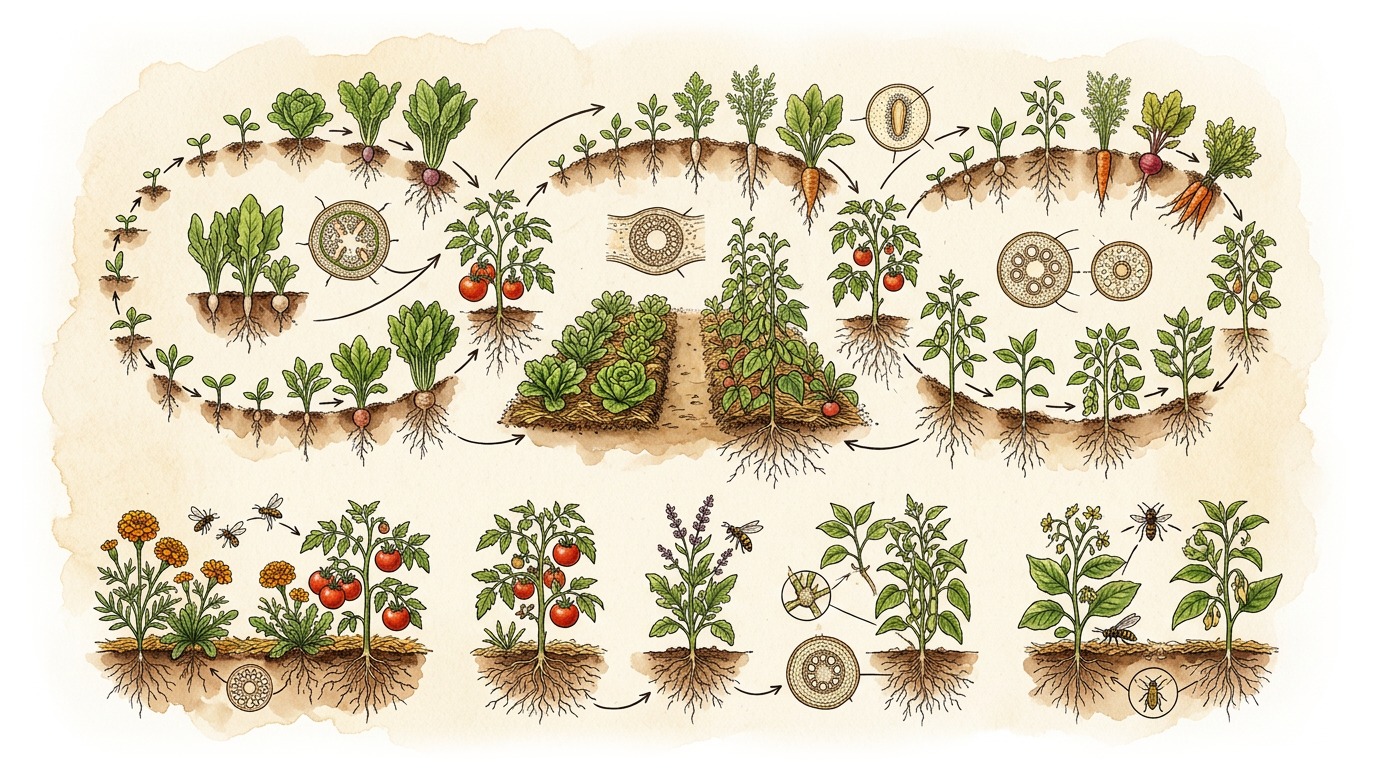
  1. Change botanical family: alternating families helps break cycles of specific diseases and pests.
  2. Change root type: this allows different depths of soil to be used and improves its structure.

taproot

tuber

22
PARTIE 22 SUR 31 3
3

3

Gourmet

4

Long

5

Nitrogen fixer

Moderate

Short

Gourmet

Undemanding,

nitrogen fixer

Long

Green manure or

harvested manure

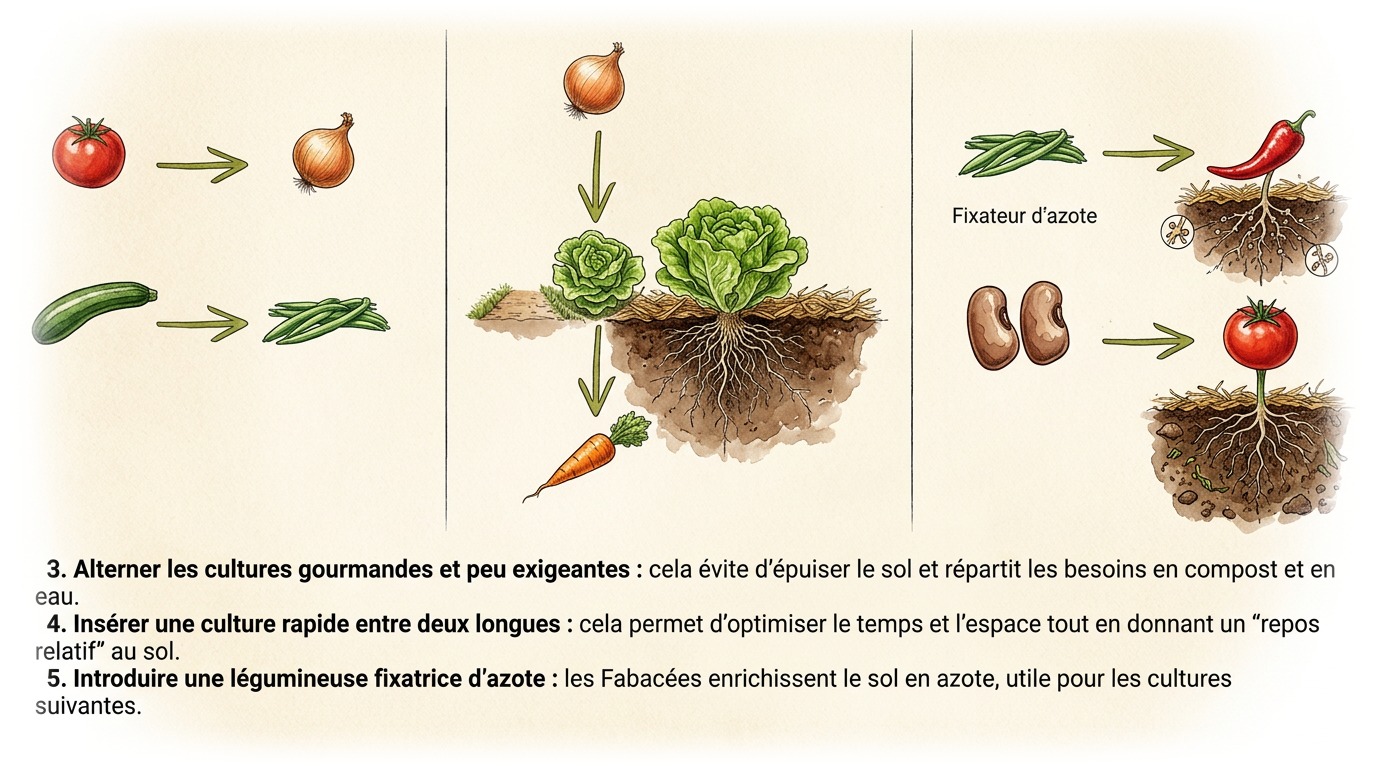
  1. Alternate between demanding and undemanding crops: this prevents soil depletion and spreads out compost and water

requirements.

  1. Insert a fast-growing crop between two long-growing crops: this optimizes time and space while giving the soil a

“relative rest.”

  1. Introduce a nitrogen-fixing legume: Fabaceae enrich the soil with nitrogen, which is useful for subsequent crops.
23
PARTIE 23 SUR 31 Example of crop rotation
Example of crop rotation

Example of crop rotation

SPECIAL CASES AND USEFUL EXCEPTIONS

24
PARTIE 24 SUR 31 1
1

1

2

Possible over two consecutive cycles, especially when

interspersed with compost application or a short break.

good ground cover,

low demand

flow demand,

good ground cover

Some crops partially escape the general rules of crop rotation. Here are two types of cases to be aware of:

  1. Low-impact crops (tolerance to repetition): certain plants with very short cycles, low requirements, and low susceptibility

to disease can be grown twice in a row without significant risk, provided the soil remains fertile and healthy.

  1. Buffer or transition crops: certain plants are considered neutral because they:

have few requirements,

are not very susceptible to disease,

do not belong to problematic families.

They can be used as a transition crop between two more demanding or risky crops.

25
PARTIE 25 SUR 31 Another strategy
Another strategy

Another strategy

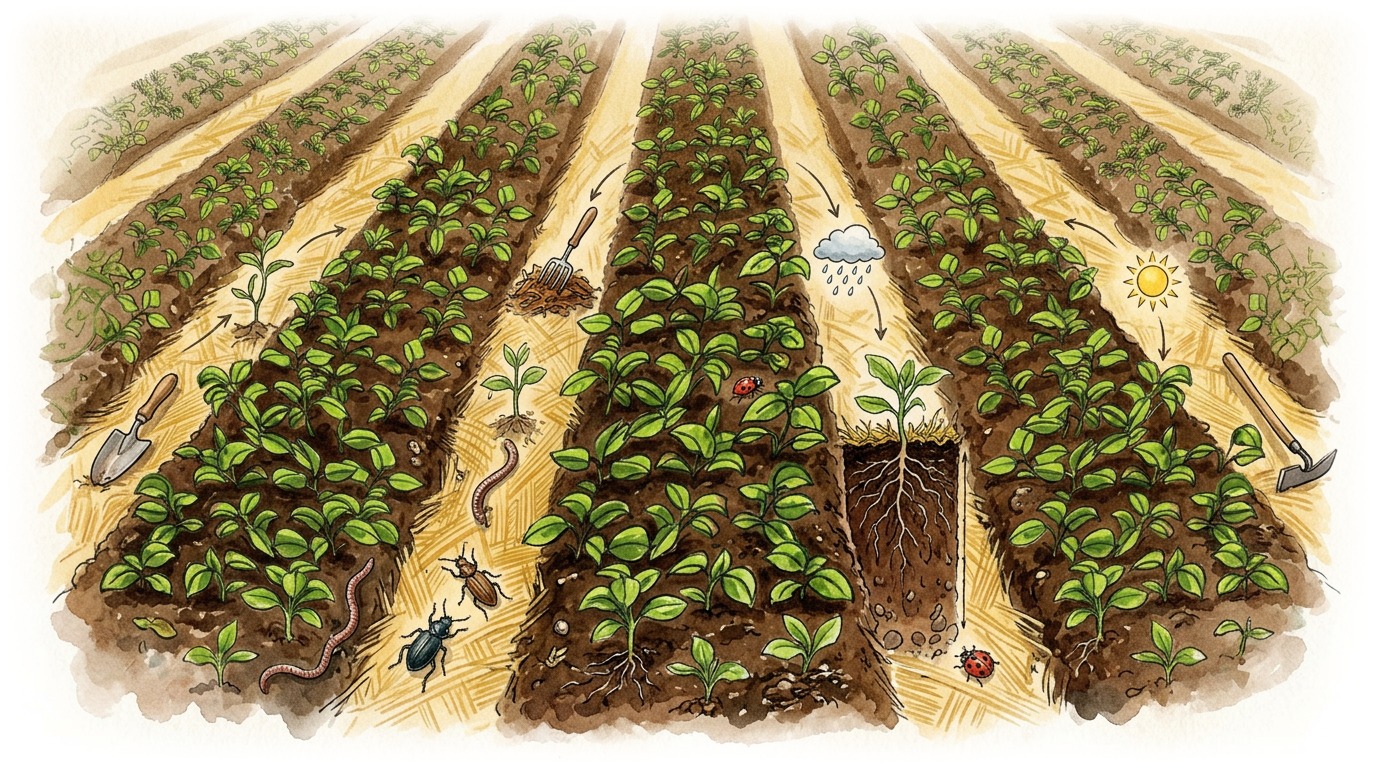
SIMPLE SEASONAL STRATEGY

26
PARTIE 26 SUR 31 Another planning strategy is to plant one main crop per season. You choose a crop that is suited to the climate, then change to a
Another planning strategy is to plant one main crop per season. You choose a crop that is suited to the climate, then change to a

Another planning strategy is to plant one main crop per season. You choose a crop that is suited to the climate, then change to a

different crop the following season.

Advantages:

Adapted to local climatic conditions

Fewer diseases (thanks to the change of seasons)

Simplified planning

Even if some crop rotations do not follow the classic rules of alternation, the change of season is often enough to break disease

cycles. Consider incorporating green manure or straw mulch every 2–3 cycles.

27
PARTIE 27 SUR 31 Green manure and soil rest: useful breaks
Green manure and soil rest: useful breaks

Green manure and soil rest: useful breaks

Green manure and soil rest: useful breaks

28
PARTIE 28 SUR 31 Green manure
Green manure

Green manure

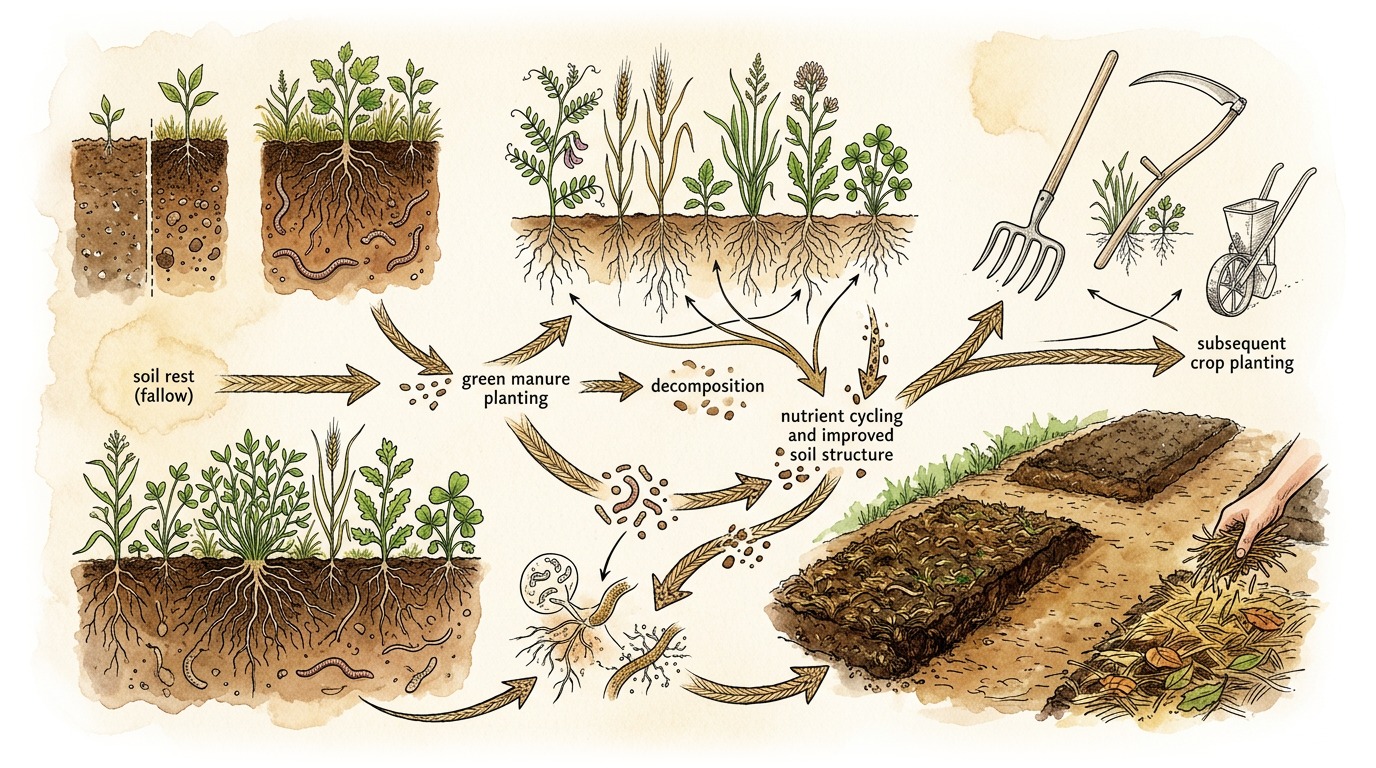
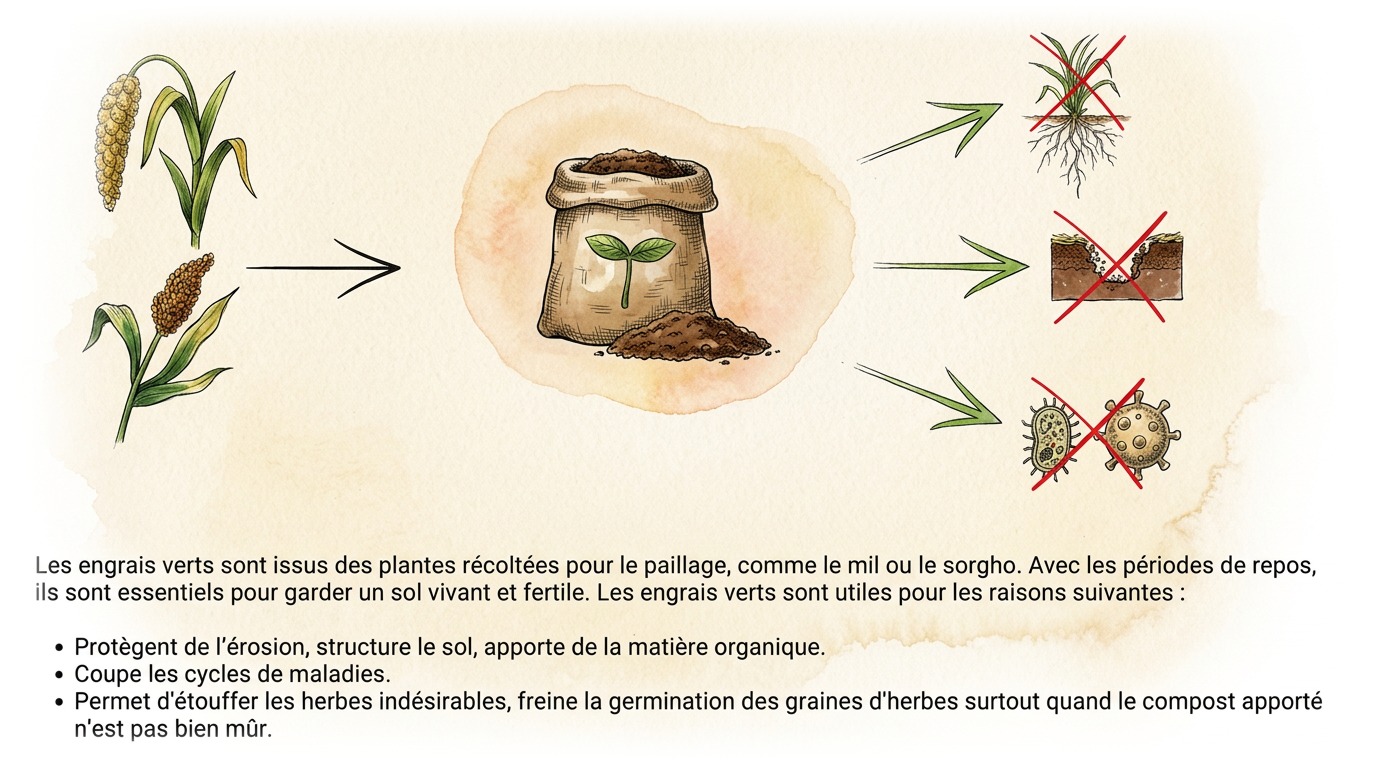
Green manure comes from plants harvested for mulching, such as millet or sorghum. Along with rests periods, they are

essential for keeping soil alive and fertile. Green manure is useful for the following reasons:

It protects against erosion, structures the soil, and provides organic matter.

They break disease cycles.

They smother unwanted weeds and inhibit weed seed germination, especially when the compost added is not fully

mature.

29
PARTIE 29 SUR 31 Rest period
Rest period

Rest period

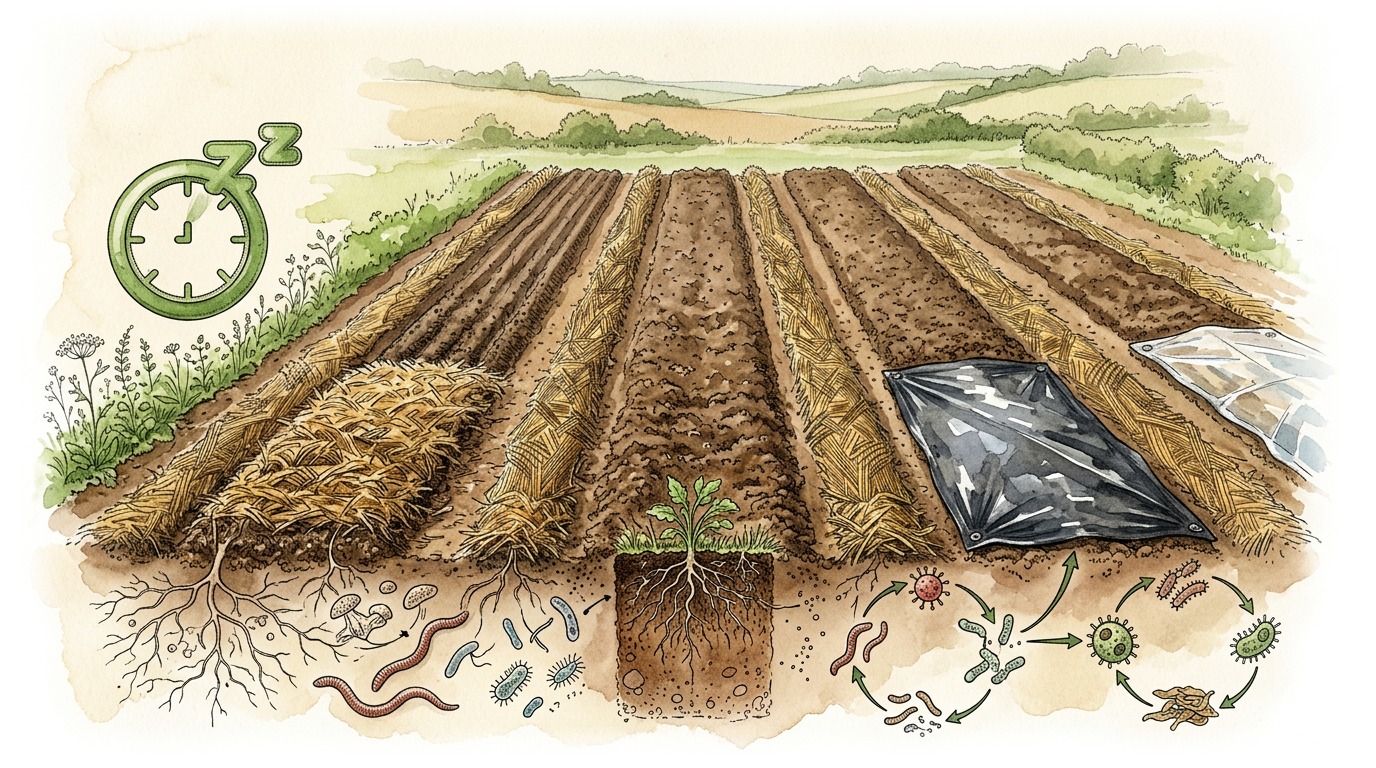
Regarding active rest:

Mulching without cultivation for 1 to 2 months.

Allows the soil to regenerate and breaks disease cycles.

Adds organic matter with mulching.

Plastic mulching (with a tarpaulin, for example) can be used to accelerate composting, maintain soil moisture, and

prevent unwanted plants.

A black tarpaulin warms the soil, while a white tarpaulin maintains the temperature.

30
PARTIE 30 SUR 31 Green manure
Green manure

Green manure

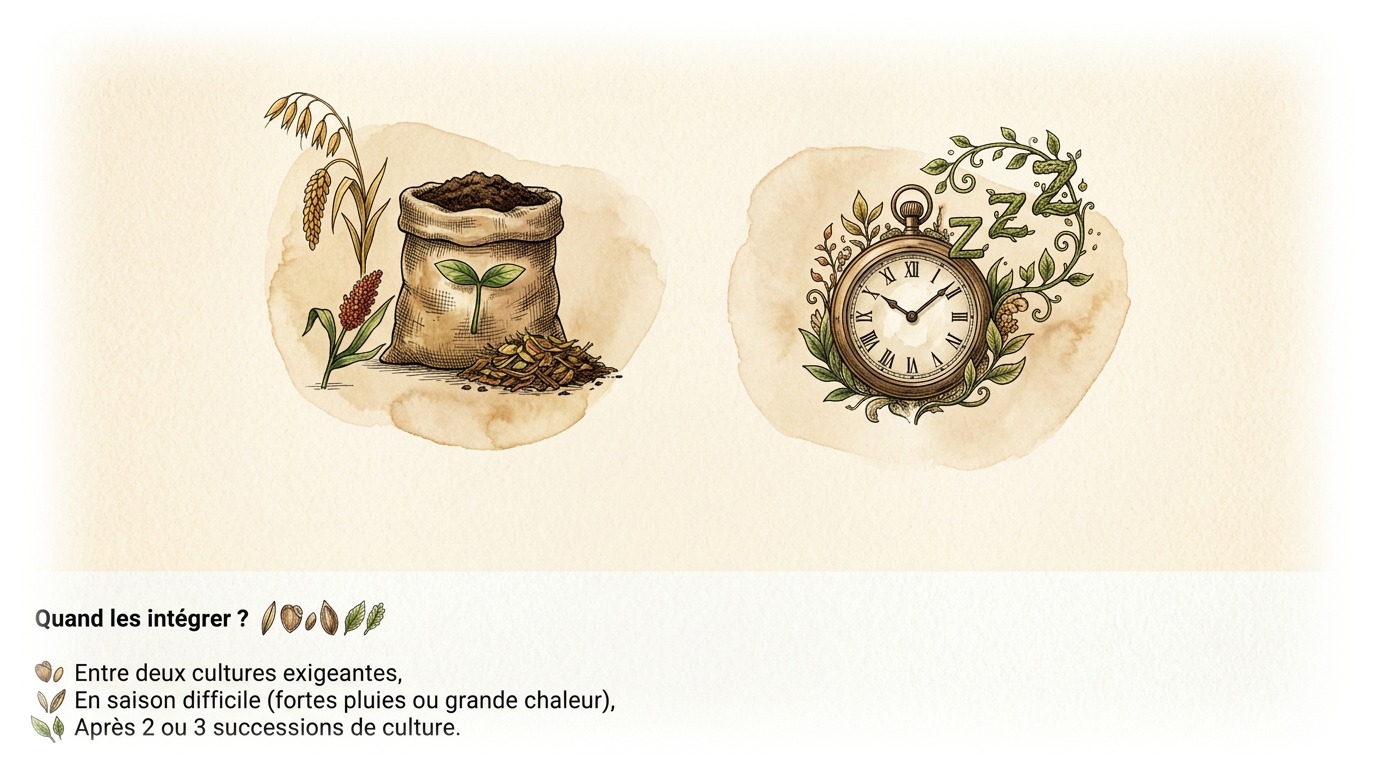
When should they be incorporated?

Between two demanding crops,

During difficult seasons (heavy rain or high temperatures),

After 2 or 3 successive crops.

Rest period

31
PARTIE 31 SUR 31 1
1

1

2

3

Good crop rotation is based on three simple principles:

  1. Change botanical families
  2. Vary root types
  3. Balance soil requirements

Adapt your strategy to the season, crop duration, and soil condition. Where possible, consider incorporating breaks with

green manure or straw mulch to naturally regenerate the soil.